Who is the Canadian?
Kris Wu is a Canadian Chinese celebrity. He started his career in Korea, before rising to stardom in his birth country, China, in the early 2010s. Since then, he has left the Korean boy band that propelled him to stratosphere, started his own agency, starred in Hollywood blockbuster, and became a defining icon in the Chinese entertainment field from 2010s till now.

What did he do?
Just like rockstars in the 70s and 80s, an entertainer with Kris Wu’s status in today’s China will never be short of fans who would want to sleep with him. Neither is Kris Wu famous for shying away from such encounters.
However, Kris Wu was recently accused of sexually assaulting a young acting school student Du Zhumei(都美竹)under the pretense of auditioning her for an upcoming tv series role. According to the victim, the incident happened in June 2020, Kris Wu promised they were going to start a relationship after getting her drunk and then sleeping with her the night before, even to the extent of promising to taker her to see his mother during Chinese New Year (In Chinese and East Asian culture, this often represents affirmation to start a serious relationship).
The victim states that she did not fall for Kris Wu’s empty promises and demanded official apology for his actions. Both sides began negotiation, with Kris Wu’s team hoping to settle the matter with a hefty compensation (1M CNY).

An interesting turn
Things take an interesting turn here: Kris Wu’s team asked the victim to sign a statement to promise not to “harass or dwell on this matter anymore” after receiving the aforementioned payment. However, Wu’s team also proposed to the victim, that they would transfer a fund totaling to 3M CNY to her first, then she should transfer 2M CNY back, keeping the 1M payment, claiming this is “for taxation reasons”. Without hearing back from the victim, Wu’s team transferred an initial sum of 500k CNY to the victim’s bank account on the same day.
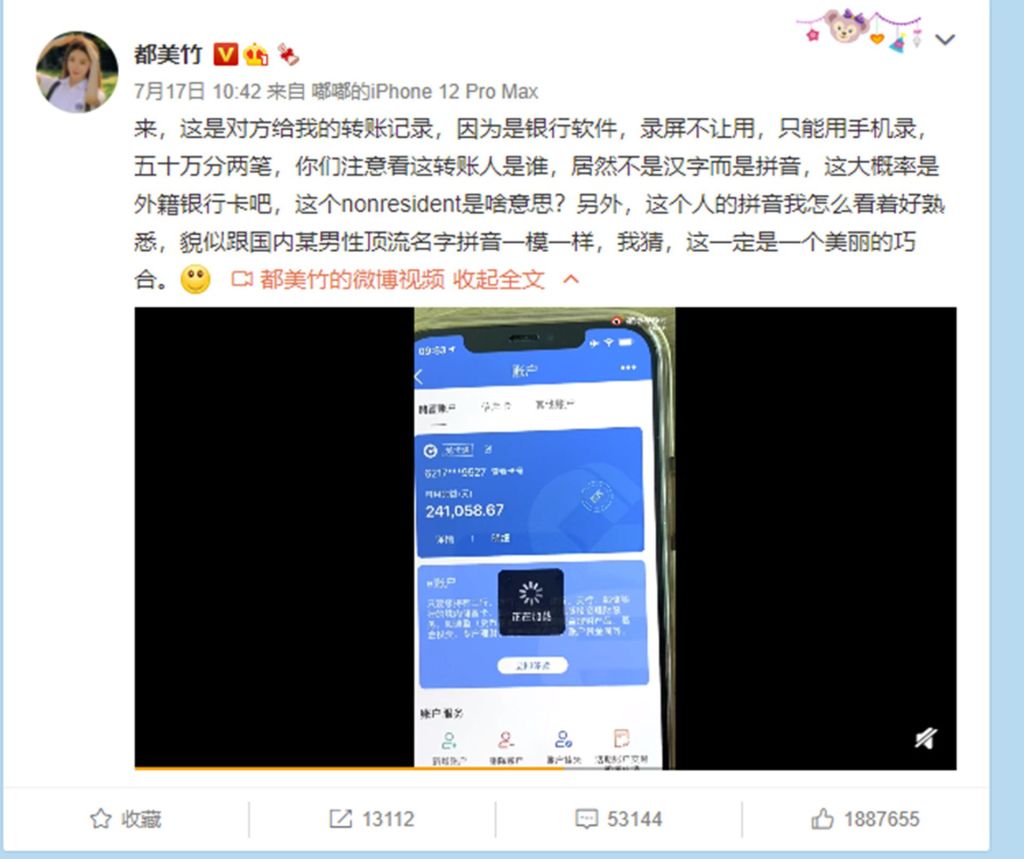
So what do all these money transfers mean? Sources familiar with the matter suggest an menacing motive hidden behind the instructions. Through the complicated transactions, Wu’s team will try to frame the victim as someone who’s goal is to extort financial gains from Wu by threatening to go public with his past actions. The process can be split into 3 stages.
Stage 1: The victim signs the compensation statement, providing evidence that her actions are financially motivated.
Stage 2: Wu’s team transfers an amount that’s way higher than the agreed sum to her, and then ask her to transfer the extra funds back due to “taxation reasons”. Sources state that this is actually Wu’s team attempting to obtain legally acceptable evidence to show that the victim is the recipient of the funds.
Stage 3: Wu’s team immediately transfers 500k to the victim, to pressurise her into following all the instructions. If she heeds to their pressure, then Wu’s team will have enough evidence to accuse her of criminal extortion, and given the sum involved (1M CNY), the minimal sentence in 10 years.
This course of action not only able to help to reverse public opinion and portray Wu as the unfortunate victim who is extorted by a crazy fan, but also discredit and prevent the original victim from bringing up this matter up again.
How did the society react?
Chinese netizens did not take the news well, as Wu has already had a track record of dumping fans after sleeping with them. Previously he has all emerged unscathed by the scandals. However, the current accusation not only involves him mistreating fans, but also contains accounts of sexual assault and rape.
Immediately after news broke, Wu lost all 15 business collaborations in mainland China, including ones with big names such as LV, Tencent.
This suggests 2 things:
1. The accusation is not entirely false, and brands take the case very seriously.
2. Business brands are terribly cautious when it comes to dealing with Chinese market and Chinese netizens. They would almost always want to play safe rather than risk losing marketshare.
Of course, it is unwise to play judge here, as with many previous incidents on the Chinese internet, the truth can be completely different from general online sentiments.
Nevertheless, the ongoing incident once again unveiled the changing sentiments online towards celebrities. They are held to a much higher moral standard than ordinary citizens in China due to the vast influence they possess. Anything less than a flawless moral track record, once exposed to the public, will be detrimental to the professional lives of celebrities.
What could happen next?
There are three possible scenarios that could develop from here. The first being the accusations against Kris Wu are proven to be true. In this case, he will almost definitely lose all his privilege and be excommunicated from the Chinese entertainment business. What’s worse is that he could be possibly facing public prosecution for various sexual crimes (including rape, and sex with minors). However, being a Canadian citizen, most likely he would be deported from China after a hefty fine, rather than facing a long jail time.
The second scenario would be the aforementioned accusatios to be false. In this case, Kris Wu would be able to continue his entertainment business in China, just like numerous times before. Then again, this incident, coupled with the huge public backlash, would definitely tarnish his reputation and affect his exposure.
The third scenario is the accusations are not completely proven false. This is actually the most likely outcome to this incident, as the accusations do hold some similarities with Kris Wu’s past doings. In this situation, In addition, Kris Wu would be marked by the Chinese netizens as a celebrity with low moral standard. Even if he did not break the law, he would almost certainly be criticized morally.


 The Sinographer