Another day, another sexual crime, another round of social media outburst
The Chinese internet went ablaze on 8th August, not for a fantastic result at the Olympic Games (more on that coming up), but furious at yet another sexual crime whose victim turned to Weibo after her pleas fall on deaf ears in internal channels. The perpetrator this time? An Alibaba executive.
An unidentified female employee of Alibaba accused her manager and a client of sexual assault during a work trip to Jinan, Shandong in Eastern China on 27th July.
The manager was accused of purposefully getting the victim drunk during dinner and sexually assaulting her when they return to her hotel room.
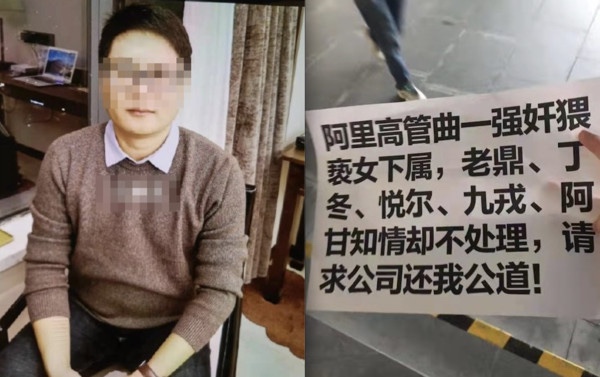
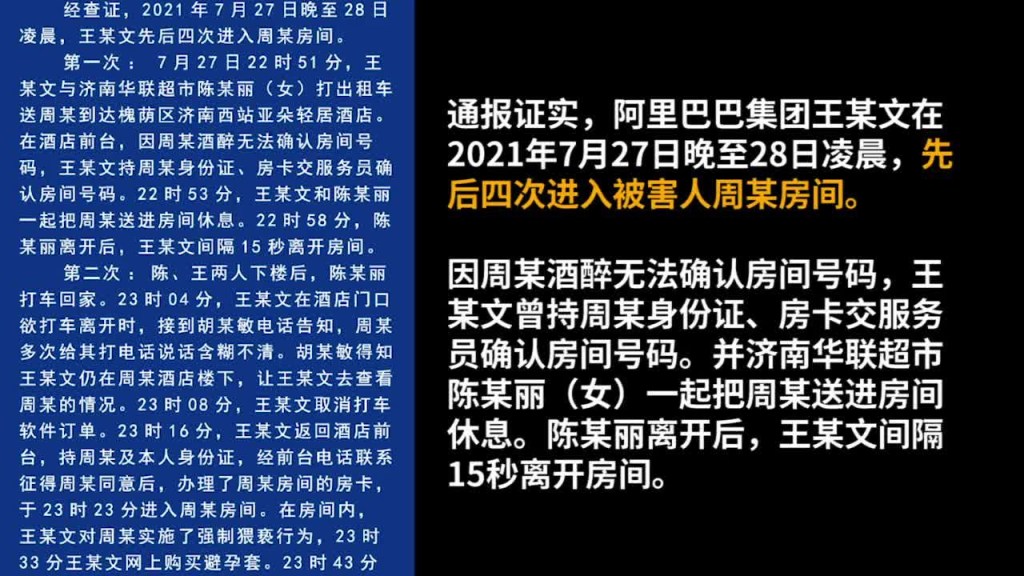
CCTV footage showed that after sending the victim back to her room with another female companion, the manager pretended to leave the hotel, before returning to the front desk to obtain another room card of the victim’s room, using it to enter her room four times.
By the victim’s account, she woke up the next morning naked, with no recollection of the past night. She also found her undergarments to be missing, and a used condom packaging in the room.
She immediately made a police report, and obtained CCTV footages from the hotel.
(Update: on 12th August, local police released the preliminary findings of the incident, confirming victim’s account that she was sexually assaulted by both her manager and one of the client. Both men have been arrested under the charge. However, police also state that there is “no evidence that rape occured”. Speculations suggest that the “no evidence of rape”statement could be due to both men removed crucial evidence from the scene that could support rape charge. Case is under further investigation.)
After the incident happened, the victim brought up the matter internally to various levels of management but to no avail.
Desperate for justice and answer, the victim first distributed flyers in Alibaba’s canteen to press higher management for a response, but she was stopped by security personnel. Shortly after, she posted her ordeal and the company’s non-response on Weibo, thus sparking a new round of criticism against Alibaba.
According to Chinese media reports, Alibaba first issued a statement late at night on 7th August, 10 days after police report has been made. In the brief boilerplate statement, Alibaba revealed that while police investigations are ongoing, the relevant employee has been suspended for violating company policies and values, and internal investigation has begun.
This statement only incurred even greater wrath from the society, many netizens felt that Alibaba showed no compassion nor sincerity, the statement was only an act to put out the fire after things blew up.
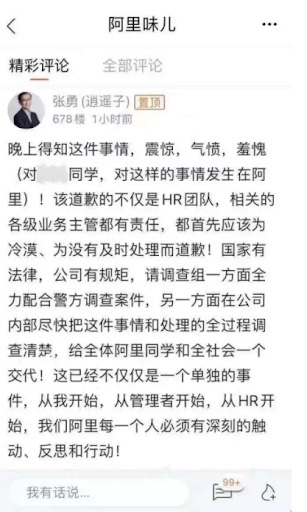
The next day, Jack Ma’s successor, Alibaba CEO Daniel Zhang issued an internal memo to staff condemning the attack and the company’s initial handling of the complaint. He said internal investigations found the accused had confessed to “intimate acts” with the woman while she was intoxicated, violating company policy.
In addition, Daniel Zhang expressed his “shock, anger, and shame” at the incident. However, netizens did not accept this statement, instead mocking him for expressing his “shock, anger, and shame” 10 days too late, only after the incident caused huge public anger.
Drinking culture is to blame?
Criticisms surrounding this case focused on three main areas: Drinking culture in the Chinese business context, Alibaba’s slow response, and the inappropriate “orientation culture” in Chinese tech giants.
Firstly, on the drinking culture in Chinese business world.
The victim reported that she was first forced to go on the ill-fated work trip by the suspect during typhoon weather. On the last day of the work trip, the suspect to her to a dinner gathering with the local partners, where she was coerced to drink with the local partners that ultimately led to her inebriation and being assaulted.
After the incident happened, senior management in Alibaba told the victim that she was expected to drink with clients and partners to maintain relationships or to secure deals. In addition, she was also being informed that the company prefer to hire male employees over female employees to avoid similar incidents.
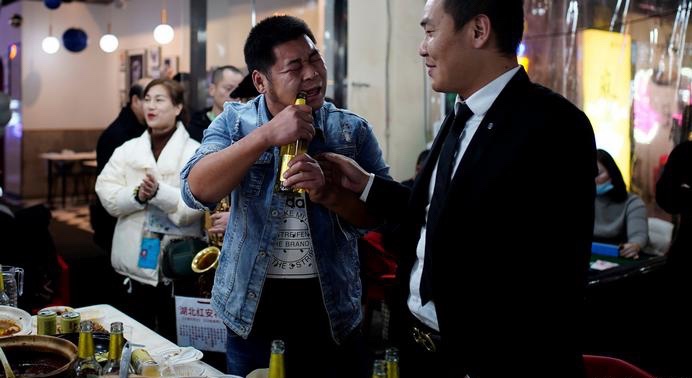
Debates on such drinking cultures are long present in the sinopshere. Business dinners is a grey area, where personal desires met with public interest. Many sees it as a legacy from the old days, where coercing a junior staff or business partner to drink and to get drunk on the dinner table is equivalent to one’s position of power and command.
The current incident once again brought about more criticisms on the drinking culture. Many sees it as sexism in nature, archaic, and disrespectful to individuals regardless of gender. Most netizens certainly did not expect it to happen to a company like Alibaba.
Secondly, Alibaba’s response is another area of criticism.
Netizens are unhappy with the company’s slow and indifferent boilerplate statements on the issue.
Even from within the company, non-managerial staffs have been voicing their displeasure on Alibaba’s internal forums and chat groups, targeting their anger at the middle management level, where the accused and his immediate supervisor belong.
Many drew comparison between Alibaba’s response in this incident with the 2016 Mooncake incident, where 4 software engineers were fired within 24 hours after they were found using bots to horde Alibaba’s Mid Autumn Festival mooncake gifts. Alibaba then issued a statement affirming that employees should uphold the highest moral standards.
Coupled with how lightly Alibaba treated Taobao/Tmall CEO Jiang Fan’s sexual scandal in 2020, netizens hence mocked Alibaba’s moral standard with the elasticity of rubber band, going harsh on lower level staffs but extremely lenient on management level.
Thirdly, The current incident also drew attention (and criticism) on the “orientation culture” that is present in Chinese tech giants like Alibaba and Tencent.
“Orientation culture” is eerily similar to hazing activities present in fraternity initiations or university orientations. In this case, new hires are asked to perform intimate tasks with their colleagues in the name of “bonding”. These tasks are often sexually explicit, and generally causes discomfort in the participants.
In addition, accounts of such “orientation” events also revealed that participants are often asked personal questions that’s bound to make them feel uncomfortable or offended. The questions, again, often revolve around individual’s sexual experiences.疼
Past incidents
Chinese companies are not without their share of misconducts, affairs, and morally ambiguous actions. In 2018, another Chinese internet giant JD was involved in what could be its largest PR crisis till date — its founder Liu Qiangdong (Richard) was arrested in Minneapolis on accounts of rape.
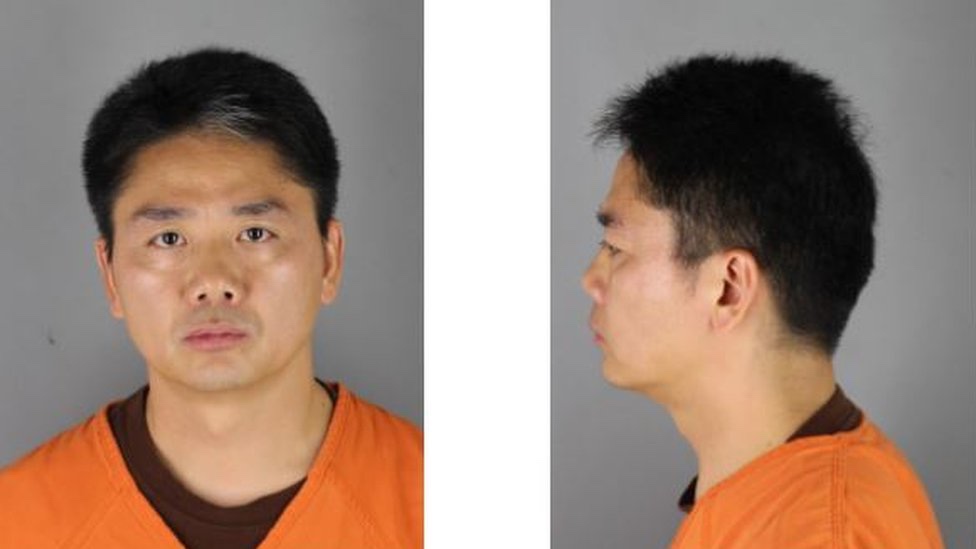
The accusations were similar to the Alibaba case today — a Chinese university student was invited to a dinner party with Liu. She was subsequently inebriated and returned to her apartment with Liu, a married man, where they had sex.
Liu Qiangdong was then accused of rape, and arrested by the local police. However, after a length legal procedure, prosecutors decided not to proceed with the rape charge, the complainant also indicated her preference of receiving a hefty sum of compensation from Liu and JD to settle the case out of court.
What could happen next?
More importantly, before this incident happened, Alibaba has always been seen as a figure of progressiveness and modernity amongst the Chinese. The current incident tears down the facade of equality and respectfulness, revealed that the 250,000 strong conglomerate’s company culture is far from what it seems.
Nevertheless, this incident and public backlash came at the worst possible timing for Alibaba. Since October 2020, Jack Ma and Alibaba has been under fire from the central government and Chinese regulators. Ant Group, a fintech unicorn founded on the success of Alibaba’s Alipay service, originally planned to go public in Hong Kong and mainland China in Nov 2020. However, the IPO was rejected by Chinese regulators at the eleventh hour. In addition, Alibaba was slapped a hefty fine ($2.8B USD) from the regulators early 2021 on the account of monopoly and market-controlling behaviours.
More importantly, Chinese netizens have been voicing their increasing displeasure against Alibaba recently. The once pride and joy of China’s technology advancement and symbolism of Chinese nationalism has turned into an embodiment of modern day tech-driven capitalism that enslaves the society.
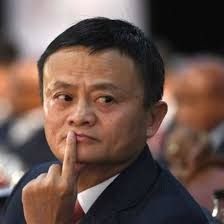
Stories of how Alibaba employees have to work from 9am to 9pm, 6 days a week led to the birth of the term “996”. Jack Ma once publicly commented that “996”should be considered as a blessing instead of oppression and exploitation, further adding to the ire of Chinese netizens.
Then again, we should also take heed that everything that’s on the internet might not reveal the whole truth. Claims from both parties should be carefully examined to reach an unbiased conclusion. While police investigations are ongoing, there have been alternative accounts of the incident surfacing, alleging that the whole incident might contain exaggerations, and that the victim actually “gave consent” for the accused to enter her room on that night.
Regardless of what actually happened on that night, public sentiment and official stand are not on Alibaba’s side.

 The Sinographer